
Fire safety is a critical concern for homes, businesses, and public spaces across the UK. Having the right fire extinguisher can make all the difference in containing a small fire before it escalates. However, not all extinguishers are created equal, they are designed for specific types of fires based on the UK’s fire classification system. These classes include:
- Class A: Fires involving solid combustibles like wood, paper, and textiles.
- Class B: Fires involving flammable liquids such as petrol or oil.
- Class C: Fires involving flammable gases like propane or butane.
- Class D: Fires involving combustible metals such as magnesium or aluminium.
- Class F: Fires involving cooking oils and fats.
- Electrical fires: Fires involving live electrical equipment (not a formal class but requires non-conductive agents).
In this article, we’ll explore the main types of portable fire extinguishers, their uses, advantages, and disadvantages. All extinguishers must comply with BS EN 3 standards for safety and effectiveness. Remember, fire extinguishers should only be used by trained individuals, and evacuation should always be the priority.
Water Fire Extinguishers
Water extinguishers, identifiable by their solid red label, are one of the most common types found in UK premises. They work by cooling the fire and soaking the fuel to prevent re-ignition. These are primarily suitable for Class A fires.
Pros:
- Cost effective and widely available.
- Excellent penetration and cooling properties, reducing the risk of re-ignition.
- Environmentally friendly with no harmful residues.
Cons:
- Limited to Class A fires only; ineffective or dangerous on other classes.
- Conducts electricity, making them unsuitable for electrical fires or near live equipment.
- Can cause water damage to property.
Foam Fire Extinguishers
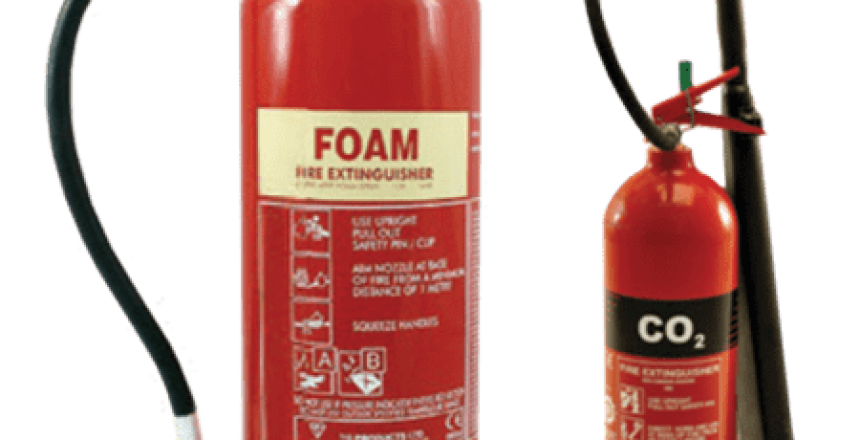
Foam extinguishers have a cream-coloured label and contain a mixture of water and foam concentrate. They form a blanket over the fire, smothering it by cutting off oxygen. Ideal for Class A and B fires.
Pros:
- Versatile for both solid and liquid fires.
- The foam barrier helps prevent re-ignition on flammable liquids.
- Some models are dielectric tested for incidental use on electrical fires up to 1,000V.
Cons:
- Can leave a residue that’s messy to clean.
- Not suitable for Class C, D, or F fires.
- Potential for foam to conduct electricity if not dielectric-rated.
Dry Powder Fire Extinguishers
These extinguishers feature a blue label and use a fine powder to interrupt the chemical reaction of the fire. Standard versions cover Classes A, B, and C, while specialist ones handle Class D.
Pros:
- Highly versatile, effective on multiple fire classes including gases and electrical (non-conductive).
- Suppresses fires quickly.
- Specialist powders available for metal fires.
Cons:
- Leaves a powdery residue that can damage electronics and is hard to clean.
- Powder can obscure vision and be inhaled in confined spaces.
- No cooling effect, increasing re-ignition risk.
CO2 (Carbon Dioxide) Fire Extinguishers
CO2 extinguishers have a black label and discharge carbon dioxide gas to displace oxygen. They are best for Class B fires and electrical fires.
Pros:
- Leaves no residue, ideal for sensitive equipment like servers or kitchens.
- Safe for electrical fires as it’s non-conductive.
- Quick to deploy with no cleanup needed.
Cons:
- Limited to specific fire types; not effective on Class A or F.
- No cooling effect, so fires may re-ignite.
- Risk of asphyxiation in enclosed areas due to oxygen displacement.
Wet Chemical Fire Extinguishers
Identified by a yellow label, wet chemical extinguishers use a potassium-based solution to create a soapy foam. They are specifically designed for Class F fires, with some suitability for Class A.
Pros:
- Highly effective on cooking oil and fat fires, preventing splattering.
- Cools the fire and forms a barrier against re-ignition.
- Safer alternative to water or foam for kitchen environments.
Cons:
- Primarily limited to Class F and some A fires.
- Can be corrosive to certain surfaces.
- More expensive than basic water extinguishers.
Water Mist Fire Extinguishers
A newer innovation with a white label, water mist extinguishers release de-ionised water as a fine mist. They are versatile for Classes A, B, C, F, and electrical fires.
Pros:
- Broad applicability across most fire classes.
- Non-conductive and leaves minimal residue.
- Environmentally safe with no chemicals.
Cons:
- Smaller size may limit discharge time.
- Higher cost due to advanced technology.
- Less effective on deep-seated Class A fires compared to traditional water.
Choosing the Right Fire Extinguisher for Your Needs
Selecting the appropriate fire extinguisher depends on the potential fire risks in your environment. For example, kitchens may require wet chemical types, while offices might benefit from CO2 for electrical hazards.
Always ensure extinguishers are regularly maintained and comply with the Regulatory Reform (Fire Safety) Order 2005 in England and Wales, or equivalent regulations in Scotland and Northern Ireland.
At LS Fire Solutions, we offer expert advice, installation, and maintenance services to keep your premises safe. Contact us today for a tailored fire risk assessment or fire safety training.
Stay safe and prepared – knowledge is your first line of defence against fire.